
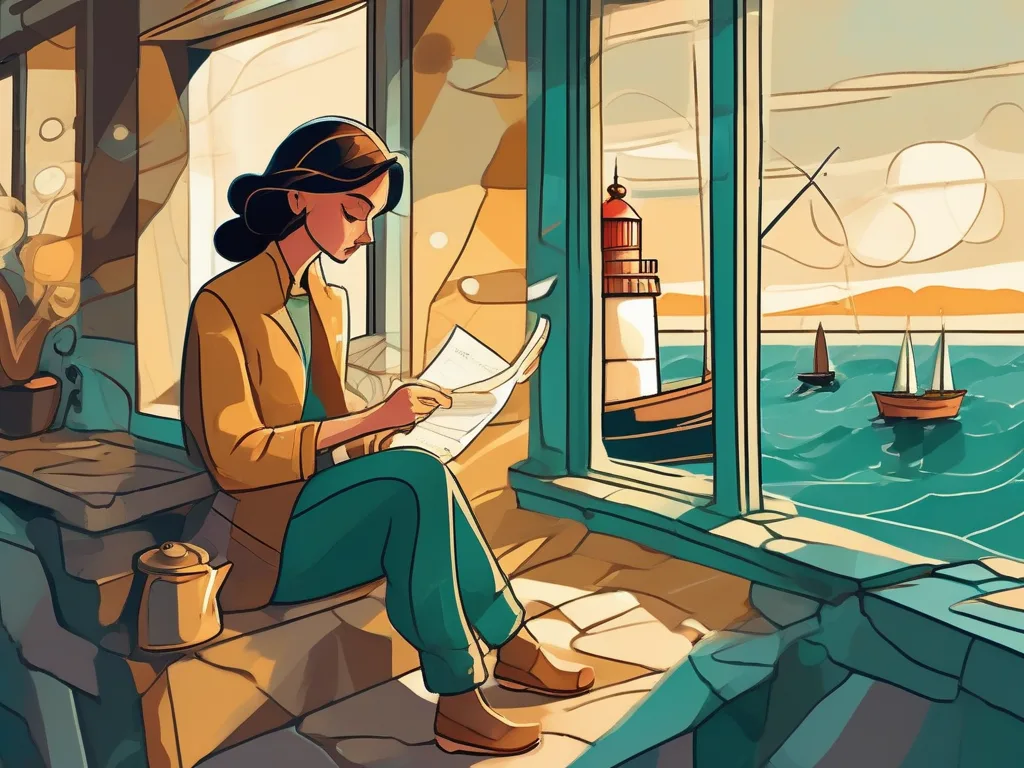
The letter arrived on a Tuesday, though it had been written forty years earlier. It was addressed to the harbour cafe, to a woman named Ines - my grandmother.
I had come to the coast to empty her house. The cafe was closed, its windows white with salt. I sat on the wall outside and opened the envelope with careful hands.
The letter was short and eloquent. "I have never forgotten the evening we watched the luminous water," it said. "I am writing now because I am leaving, and I wanted someone to know that it mattered."
There was no signature. Only a date, and the name of a boat: the Marigold.
Ines had never spoken of a boat. She had spoken of the sea, of her childhood, of the long afternoons when the light turned gold. But not of this.
I asked the old woman who ran the fish shop. Her eyes changed when I said the name. "The Marigold," she said. "Your grandmother painted it. She was no sailor, but she loved the water."
That evening, I walked to the anchor at the end of the pier. Ines used to bring me here as a child. We would watch the boats come in and she would say, "You never know what the tide will bring."
On the back of the letter, in small pencil, I found a line I had missed: "Look after the cafe. Look after the light."
The cafe had been for sale for months. I had told myself I was going to sell it. But that night, standing there, I felt something I could only call serendipity - the unexpected feeling that one small letter had changed the direction of my life.
I opened the cafe again the next spring. I kept the old sign. Sometimes, in the evening, I read the letter to the new customers, and we share a moment of nostalgia for people and places we never knew.
The water still turns luminous at sunset. I have learned that gratitude can be a place, and that an anchor does not only hold a boat still. Sometimes it holds a whole story.
A thought to keep
You never know what the tide will bring.